Showing posts with label painting. Show all posts
Showing posts with label painting. Show all posts
Thursday, October 22, 2009
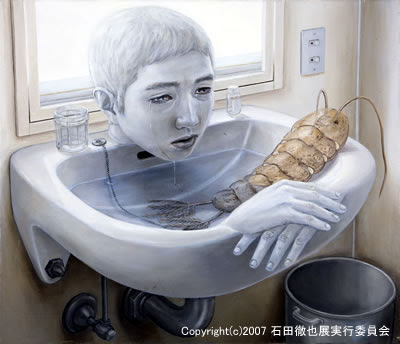
Tetsuya Ishida
Several douban friends recommended Tetsuya Ishida's paintings. I thus came to know this talented Japanese painter who died in 2005 at the age of 31 (probably a suicide). His surreal self portraits remind me so much of Frida Kahlo. His own body is frequently presented as part of a machine or a built object, tragically trapped in the suffocating urban surroundings. Through his desperate gazes, we sense his deep loss of freedom, identity, emotion, nature, childhood joys...


Sunday, April 19, 2009
Cat Score

The Sound of Painting is a fascinating and informative book I read recently. It explores the mutual inspiration between early modern art and early modern music by examining numerous artists’ works inspired by music.
In the chapter of Graphic Music, I was intrigued by several pieces of work which innovatively visualized music. The wittiest one is this Cat Symphony by Austrian painter Moritz won Schwind (1804-1871). He dedicated the score to Joseph Joachim (1831-1907), a renowned Hungarian violinist and composer. He described his idea of reforming the linear notation system as ‘this darling attempt to put a more expressive, spiritualized notation system in the place of this outmoded, obsolete, pedantic, and dry-as-dust copycat business.’
Friday, June 6, 2008
2 Great Art TV Series

I recently watched Simon Schama’s The Power of Art. It’s an excellent TV series on 8 genius artists in history, written and presented by Prof. Schama. I have to admit that BBC makes the most refined educational documentaries, since the quality of storytelling, photography, music and visual effects are almost perfect. The story of each painter is told in an adequately visual way: the important events and characters are acted out, others are illustrated with metaphorical images. The part of storytelling, painting presentation and Schama’s insightful comments are well integrated.

At a few times, a painting made me cry. I would not have been so touched without the profound background and analysis given by Schama. I gained a much more comprehensive knowledge about those artists. For instance, I knew Turner as merely a romantic landscape painter before. After watching the show, I realized I overlooked the most powerful aspect of his works - those depict the devastating disasters in human history, esp. Slave Ship as an emotional representation of the shockingly inhumane event happened in 1781.

Compared to the high-cost BBC series, PBS makes intriguing and informative documentaries at low budgets. A good TV series I watched recently is Art:21 which offers a great introduction into contemporary visual art. The show covers 72 influential artists living is US, including my familiar ones like James Turrell, Richard Sara, Cai Guoqiang, Maya Lin and Krzysztof Wodiczko, as well as many others I didn’t know of. The best part is seeing the work process of each artist, accompanied with the artist’s own interpretation. Each episode presents a theme by introducing 4 related artists. I can understand the advantages of doing that. But often times I found the artists’ works don’t fit into just one category. By sorting them out, it simplifies the broadness and complexity of the artist’s approach. That’s my only criticism of the show.
Tuesday, May 13, 2008
Black Monday

Earthquake, by Stack (source)
I had to replace the earthquake photo with an abtract painting, 'cause it's too painful to look at such photos everywhere these days. The death poll has hit almost 15,000 by now with over 25,000 people still buried in debris....
I can't helping thinking that even with all the science and technology we have mastered today, we are still not able to accurately predict earthquake or other natural disasters. When facing disasters, we are much more vulnerable and ignorant than animals who can sense changes in the environment way ahead of us.
P.S. reliable and convenient donation sites for people in US -
Mercy Corps: http://www.mercycorps.org/
Global Giving: http://www.globalgiving.com/
Monday, April 14, 2008
Drawing into Film
The book Drawing into Film is a terrific collection of drawings from 13 renowned filmmakers. Again, I feel the strong similarities between a film director and an architect: they both sketch a lot, they both deal with time, space and movement, they both go through the process of production/construction, they both face the challenge of budget, they both are involved in substantial leadership and collaboration...
It was my first time seeing the drawings or sketches from several of my favorite filmmakers. I was quite amazed by their imaginative thinking process as well as visualization skills. The following are the ones I love the most -
Once was a cartoonist, Fellini took advantage of his drawing skills in filmmaking. These cartoonish sketches were made for Amarcord (1974) and Città delle donne, La (1980).

I've seen Orson Welles' paintings in the documentary One Man Band before and was deeply impressed with his versatility. His paintings are as free and powerful as his mind. These are the sketches for Macbeth (1948).

David Lynch really surprised me with his classic style pencil sketches. You would think his drawings are as wild as his films! The following sketches are for Eraserhead (1978) and Dune (1984).

Of all the filmmakers included in this book, the most audacious in using colors is Akira Kurosawa. His color choices remind me of Van Gogh. These are a couple of drawings for Dreams (1990).

Tuesday, March 25, 2008
In the Realms of the Unreal

I just watched this awesome documentary on Henry Darger, recommended by Renee (again!). It tells the true story of this poor and solitary janitor in Chicago who did a 15,000 page novel named The Realms of the Unreal together with 300 paintings in his life. All his works were only discovered by his landlady after his death.
The film presents to us two pictures of Henry Darger: his social picture which is very limited and almost invisible; his inner picture, his private art world, which is in contrast so overwhelming and rich. His isolated way of living left the world little evidence of his physical existence, except three photos of himself, one friend and a few acquaintances. Instead of trying to create an objective biography, the film rather explores Henry’s mysterious inner world by blending in a large amount of his paintings, writings and autobiography with limited source of interviews and photographs. Through his works, we see his constant inner struggle with God, his eccentric vision of kids, his expression for peace and freedom… The strangely beautiful art world Henry created is the ultimate world he lived in.
From a presentation perspective, the animation of Henry’s original paintings is quite appealing and innovative. The juxtaposition of the blooming time images of Chicago with Henry’s fantasy characters makes sharp contrast between two different time and atmosphere which paradoxically coexisted. These imaginative techniques employed in the film simply accord with the incredible imagination inside Henry.
Worth mentioning, director Jessica Yu spent five years in making this film including extensive research on Henry’s works. I appreciate her efforts to show us the work and life of such a hidden genius.
Tuesday, January 8, 2008
Two Distorted Faces
I became interested in Czech surrealist filmmaker Jan Švankmajer's works recently. Tma/Svetlo/Tma is a genius short animation which displays how a human body is reconstructed by himself in a small and enclosed room.
The following still presents one of the most emotional moments in the film, a moment of both self-construction and self-destruction. It also recalls Edvard Munch's famous painting The Scream. The former distorted face is self-contained which let us reflect on our own forces affecting the shape of our body, ultimately the shape of our mind; the latter distorted face, together with the landscape, represents an inner fear or anxiety totally played inside out and remains mysterious. The figures in both images are tortured, either in a highly confined space or a vast open space. 
Dimensions of Dialogue, my most favorite one, also exemplifies Jan Švankmajer's obssession with human body and his distinctive use of clay.
Thursday, December 27, 2007
Tibetan Mandala

When watching the documentary 10 Questions for Dalai Lama, the making of a Tibetan Mandala aroused my interest. Using colored sand, the monks make intricate patterns out of colored sand, which represents a microcosm of the divine powers at work. What impressed me is not just the beautiful patterns they created, but rather the way they deal with the finished piece: instead of hanging it on the wall of the temple, they place the artwork in a river and let it decompose with the flowing water. This sense of temporality is key to the Buddhist belief. An immediate association is the artworks of Andy Goldsworthy.
Saturday, April 7, 2007
3 Images

Observatory Time - The Lovers, painting by Man Ray, 1934
 Women playing chess on the beach, from Maya Deren's At Land, 1944

Knight and Death playing chess on the beach, from Ingmar Bergman's The Seventh Seal
I found myself very interested in Surrealism recently and happened to notice the similar theme, chess board on the beach, existed in Man Ray's painting Observatory Time - The Lovers even 10 years before Maya's film. This painting might bear some influence from Dali's famous The Persistence of Memory. Although best known for his avant-garde photography, Man Ray was an artist in many other media such as painting, film, sculpture and collage.


Thursday, March 29, 2007
Big Fish Eating Little Fish

Besides Pieter Bruegel's famous painting The Tower of Babel, I saw another interesting one today Big Fish Eating Little Fish (Thanks for the book, Budi!) In the foreground, the man in the boat with his son is pointing at the scene. The Flemish inscription below the painting says: "Look son, I have long known that the big fish eat the small." Fish seem both omnipresent and omnipotent in the painting - we even see flying fish. The presence and power of fish gets transformed into human: human figures are "fishized", esp. the walking "fishman" (or "manfish"?) to the right of the giant fish, as well as the fisherman to the left with a fish-like body. Is it a hint by the artist that we are no different than fish in this ruthless and senseless world?
Subscribe to:
Posts (Atom)