Showing posts with label architecture. Show all posts

Saturday, January 9, 2010

New Acropolis Museum

Although my trip was dominated by ancient architecture, I still hoped to check out some new buildings. Since Zaha’s MAXXI museum in Rome was not open yet, the New Acropolis Museum by Tschumi became my biggest interest for modern architecture.

The museum came into sight right after I walked out of the metro station. It’s much closer to the Acropolis than I imagined. The building has three articulated levels: the ground level is aligned with the old city grid, while the top level (the Parthenon Gallery) is aligned with the Parthenon. A visual dialogue is created between the museum and the Acropolis: first, the museum is built right above some archeological remains dated back almost 2500 years.


Second, the café terrace on the second floor both overlooks the excavations and embraces the view of the Acropolis. Third, the curtain wall in the Parthenon Gallery also offers a great view of the Parthenon itself.


The glass floors at different levels create a vertical transparency. It exhibits not only the excavations beneath the first floor, but also the people walking on the floor above. Natural light is maximized in exhibition space by the use of skylights and curtain wall. It is amazing to see the sculptures under the constantly changing daylight, quite similar to their original outdoor condition. (the interior pictures are from the internet since photos are forbidden inside the museum)


Tschumi always claims film’s strong influence on his design. Some cinematic effects are quite noticeable in the museum. For instance, in the Parthenon Gallery the marbles of the Parthenon Frieze are oriented in their original locations, with the missing portions left blank. Each framed marble panel reminds me of a single film frame displayed in sequence for storytelling. The Parthenon in direct view also provides the perfect context for appreciating the artwork.


Another filmic infusion is the evening projection of the Erechtheion caryatids on the façade. I missed it as I had to go back to the ship before dark:(


I love the simplicity and elegance of the museum which reflects the essence of Greek architecture. Admission is only 1 EUR, unbelievable for a world-class museum like this!

Monday, December 28, 2009

Surprise in Ancona

I didn’t expect much of Ancona before the trip, as Google Image only came up with some unattractive photos. However, when I walked deeper and deeper into the city , I discovered some unpretentious but interesting buildings.


One of the surprises is this contemporary apartment building among the classic blocks. It sits on a slope with its roof sloping in the same direction. The form of the building is not uncommon, a popular method of carving into one big block. A balance between individuality and unity is achieved by providing each unit a good amount of character.


Walking along the stepped street in front of the building was interestingly pleasant, as I observed the changing face of each window and various plants along the street or on the balconies. As I walked up the steps, I saw another building with a similar look further up the slope. But I found this one more appealing because of the terraced garden on the back.


The landscape design is so modest but charming, just like Ancona itself. I especially enjoyed the various paths leading to different levels and directions, and the rich texture of the paving bricks...


Thanks to Google Earth, I not only located the building, but also got to see the overall plan. The aerial photo even reveals some interesting designs on the roof terrace.


Thursday, October 15, 2009

The Book Loft

Reading my friend's negative comments on the Book Loft made me want to write something about this unique bookstore. To me, the Book Loft is more than just a bookstore. It stands as a living example of dynamics in architectural space. Firstly, it blurs the boundary between public and private space and reverses the normal condition: a public bookstore in the setting of a private house. Isn’t the reversal of dining room and bathroom in Buñuel's The Phantom of Liberty an extreme case on this subject?!


One of the bookstore’s charms lies in its linear courtyard as the main entry. This serenely beautiful courtyard immediately turns the street scale into a personal scale, brings one’s mind into a peaceful retreat. Further down the path, the display windows on your right side create another type of storefront which is immersed in the domestic atmosphere rather than a commercial street feeling. Bathed in the warm yellow light at night, one can easily have the sense of going home on a cold winter night.

The linear courtyard reminds me of a charming little community garden I once visited in Philly. It is a water garden on the side of an old building, about the same size and shape as the one at the Book Loft. A ‘beer barrel’ at the corner collects stormwater from the neighboring roof which is reused for irrigating the garden. Three correlative murals depicting water cycles were done by the kids in the community.


Secondly, the Book Loft stands as a proof that getting lost is not necessarily a negative quality of architecture. This old Victorian house is a labyrinth that consists of 32 rooms of books, endless passageways, and staircases leading into new dimensions. However, this place is meant for wondering, exploring and getting lost only if you enjoy such a slow-paced and adventurous shopping experience. Associated with the quest for knowledge, isn’t the labyrinth a perfect metaphor for a bookstore? I still get lost after being there quite a few times, and each time I discover some new territories in both the architectural space and book collection. It is a similar experience every time I revisit a favorite film, picking up some unnoticed details.


Unlike box-shaped chain bookstores where one is always under surveillance, this maze-like space offers a perfect hiding place among the book jungles, which is rarely found in contemporary architecture. The Book Loft is probably a place Mr. Hulot would love! Anyone who is familiar with Tati’s Playtime knows that a large minimal glass cube is no more directional than the Book Loft, needless to say the lack of spatial interest or human attachment people can get out of.

I agree with my friend that their book selection needs to be improved. It would be great to include rare books and used books. Amazon is definitely the best place if you only care about selection and price. Nevertheless I still find Book Loft a hidden gem in this suburban city especially considering the fun experience it provides. Looking forward to my next half-day retreat, Hmmm…

Wednesday, March 18, 2009

Sun House in Haiti

I'm working on a rendering for a building in Haiti this week, which makes me wonder about the architecture there. What kind of building should we propose for the people and environment there as Haiti remains the poorest Caribbean country?

I found The Sun House, an earthbag building project at Pwoje Espwa in Southern Haiti. Father Marc Boisvert, the founder and director of Pwoje Espwa (http://www.freethekids.org/), has dedicated his life to serving and helping suffering children. This project not only houses over 700 children, but has an agricultural project, three schools, carpentry and masonry facilities, and an arts and crafts program.


The finished building is quite charming especially after the local artists' decoration. What a perfect fusion of the sustainable building techniques and the unique Haitian art and culture! More process photos can be found here: http://earthbagbuilding.com/projects/haiti.htm


The website EarthBuilding.com offers comprehensive information on earthbag construction, and I learned a lot about the advantages of this building technique. First, earthbag building is very low-cost and easy to build. Second, earthbags function well as either thermal mass or insulation, depending on what the bags are filled with. Third, earthbag structure can be fairly strong if properly constructed. Fourth, earthbag technique works better with non-rectilinear shapes, thus becomes a great tool for creating unique sculptural forms. I'm so tempted to build one myself!


As my Haitian dream continues, I watched Divine Horsemen: The Living Gods of Haiti, an unfinished documentary made by Maya Deren filming the voodoo rituals in Haiti. It's remniscent of Eisenstein's unfinished masterpiece ¡Que viva Mexico! which captures the soul of Mexican culture and its tragic history.

Tuesday, November 18, 2008

Casapueblo


Today on Travel Channel Samantha Brown: Passport to Latin America features Montevideo, Uruguay. My favorite spot there is Casapueblo, a hotel+museum+gallery designed by well-known artist Carlos Paez Vilaró. Sitting on the cliffs, this 13-story building embraces the extraordinary view of the ocean. No straight lines but only organic forms are found throughout the space. He actually built up the walls with his own hands and a simple shovel, just like working on a huge piece of sculpture.

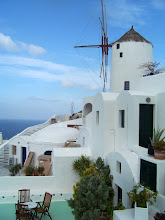
To me, Casapueblo is a combination of the white buildings of Oia Santorini and Gaudi's free forms exemplified in Casa Mila. I'll have to check out all these places in my life!

Monday, October 20, 2008

Gaudi's Architecture in Films

The Passenger is another fascinating film about alienation from Antonioni. The stunning cinematography presents quite a journey from North Africa to London and finally to Barcelona. The female protagonist is an architecture student who accidentally meets the male protagonist (Jack Nickolson) in Barcelona. My favorite scene depicts Gaudi’s Casa Mila where the two meet each other on the rooftop. The following is a Youtube clip in which the original soundtrack was replaced -


Gaudi’s fantastic Sagrada Familia is featured in the film L’auberge Espagnole. The camera reveals the tour of climbing up this exotic church and getting a panoramic view of the city.

For a panoramic view of Gaudi’s works, you can't miss Antonio Gaudi, a documentary by Japanese director Hiroshi Teshigahara. Without voice-overs or commentaries, this unique documentary offers a pure visual presentation of Gaudi's expressive architecture, as if the spaces speak for themselves. The crafted soundtrack adds another layer to the haunting beauty of architecture.

Monday, October 13, 2008

The Wrong House: The Architecture of Alfred Hitchcock


I just finished reading this fascinating book about the architecture in Hitchcock's films. The book gives in-depth discussions on Hitchcock’s unique way of set design and filming techniques based on his profound understanding of space and visual way of thinking. The first two parts of the book focus on an overall account of Hitchcock’s set design, conspicuous architectural motifs, his interests in tourism and so forth. The third part provides detailed analysis of 26 houses from 22 Hitchcock films. Drawings including floor plans, sections and site plans were presented to facilitate the understanding of architectural space.

In order to gain full control of a scene, Hitchcock preferred set shooting over location shooting all his life. From the book, I discovered that some of the most memorable shots were actually made from matte paintings or miniature models. For instance, in Rebecca all the exterior shots of the mansion Manderley were made from different-sized miniatures combined with studio effects, while all the rooms were studio sets. In Vertigo, the tower where the two deaths happen was set up solely for the film. The bird’s-eye view of the tower was just a matte painting. I was amazed at how well those special effects fooled the eyes of contemporary viewers considering some were made 70 years ago.

The chapter on Hitchcock’s preference in domestic setting is also intriguing. The typical Hitchcockian horror exists in a hidden dimension, a horrific dimension underlying our most familiar environments, especially houses. Many of the most terrifying scenes happen in either a house or a motel room, which is best exemplified in Psycho and The Birds. However, Hitchcock did sometimes take strong interests in the tourist gaze. Quite a few dramatic scenes were shot at national monuments such as Mt. Rushmore in North by Northwest and Statue of Liberty in Saboteur. The landmarks shown in Vertigo also make San Francisco even more irresistible to fans like me - I visited most filmming locations of Vertigo the first time I was in San Francisco.

As discussed in the book, the objects in Hitchcock’s films are “never mere props”, but “the very substance of his cinema”. The objects often associate with symbolic meanings, link with tensions and terrors, or even seem alive. Many of these objects are architectural elements, such as a door, a window or a staircase, which have formed some famous Hitchcockian motifs. After reading the insightful analysis on many key objects, I came to realize how many visual details I’ve overlooked during previous viewings. I will go back to those films again for new discoveries.

In short, this book offers a comprehensive examination on architecture’s role in Hitchcock’s films. Despite its theoretical quality, the book is graphically alluring by blending original frames, behind-the-scene photos and architectural drawings. The author also wittily rephrased some Hitchcock’s film names into his key titles, from the book title to some of the chapter names. If you are a Hitchcock fan, you are gonna love this book!

Monday, September 22, 2008

Mexico Trip - Palenque


All of four Maya ruins we visited are impressive. The huge pyramids make Teotihuacán the most spectacular; the small-scale ruins against the turquoise Caribbean sea make Tulum the most charming; the various architectural styles make Chichen Itza the most architecturally striking. But my #1 favorite is Palenque, a Maya city built between the 7th C and 10th C located in the state of Chiapas. Palenque gained its name from the village Santo Domingo de Palenque 9km away, since its original name was lost in time. Palenque seems more breathtaking due to its dramatic geographic setting. The morning mists in the mountains add an otherworldly atmosphere to the ruins.

First discovered in 1773, Palenque has been photographed and documented a few times by European expeditions. The first professional excavation took place 1949-1952 led by
Mexican archaeologists. The excavation still continues today, and archaeologists estimate that only 5% of the whole city has been uncovered so far! Since Palenque was deeply buried in the jungles for centuries, the process of revealing it was exactly the opposite of creating a new park: instead of building everything out of nothing, Palenque was unveiled by removing everything around it, a method of subtraction rather than addition.

Of all the visible structures in Palenque, the palace is the most fascinating to me. The whole palace is a maze: as you walk, you pass through different corridors, courtyards and rooms, while the tall tower always forms a visual center and implies the directions. Beautiful carvings are found on huge stone slabs in some courtyards. The palace is at once architecturally sophisticated and spatially interesting.


East of Palenque in Guatemala stands the larger Maya ruin Tikal. Hopefully I can get there someday!

Saturday, September 20, 2008

Cool Interiors from Paul van Dyk's MV

I watched Paul van Dyk's DVD Global, a MV collection filmed in several cities around the world. I was fascinated with the cool interiors shown in this MV Tell Me Why, hoping to find more info on the design.

Tuesday, September 16, 2008

Mexico City - José Vasconcelos Library


Before my trip, I saw the above interior photos of José Vasconcelos Library, a huge and modern library in Mexico City. But when I really got there, I was disappointed to find it has been closed for a while. The newly updated wiki page gives the following account -

The Library had to be closed down in March 2007 because of defects of construction. The Superior Auditor of the Federation detected 36 irregularities in its construction and issued 13 motions of responsibility for public servants of the federal government. Among the irregularities found was the misplacement of marble blocks at a cost of 15 million pesos (roughly 1.4 million dollars).

What a shame such a good design didn't get built well and so much money was wasted! I happened to find someone's blog with many pics of this library when it was still in use -

Saturday, September 13, 2008

Mexico City - Luis Barragán


Luis Barragán is the most important figure in Mexican modern architecture. Visiting his house and studio naturally became a priority for our 2-day in Mexico City. Trained as an engineer, he practiced as a designer in not only architecture, but also furniture and gardens.

The solid surface at the entrance separates the house completely from the street. The interior presents a totally different world filled with light and colors. The main space is double-height, and divided by low walls. The huge window opening to the garden blurs the boundary between inside and outside. The nicely designed garden forms a mini jungle in the courtyard.

Barragán widely traveled in his earlier life, so a good collection of books and crafts from various nations are found throughout his house. Inspired by Le Corbusier and Mies, Barragán's design shows a pefect fusion between European modernism and indigenous cultures of Mexico.


Light and shadow was a major interest in his design, for instance, the play with light and shadow by adjustable shutters, the use of windows and skylights to embrace views and natural light. The subtle use of light and shadow simply adds a phenomenal quality to his minimalist style, which also had a strong influence on Tadao Ando.

The house is an introvert space speaking of its own language inside the
bustling city, a space of poetry written in light, texture and color. Unfortunately, we didn't have time for Francisco Gilardi House and Tlalpan Chapel, two of his excellent works in Mexico City.
(Note: Photos are only allowed at the roof terrace, so I had to use internet pics for other areas)

Wednesday, September 10, 2008

Mexico City - Blue House


My travel motivation often comes from film. I had been dreaming about Mexico City since I watched the film Frida (2002). The images in the film are just unforgettable: the vibrant colors of Mexican architecture, the spectacular pyramids of Teotihuacan, and of course the imaginative paintings by Frida...I became more eager to see Mexico after seeing Sergei Eisenstein's fabulous documentary Que Viva Mexico! (1932) in which he captured the Mexican charm at its purest.

The 'blue house' where Frida grew up has become today's Frida Kahlo Museum. It's located in Coyoacán, a cultural neighborhood in the south of the city. Eisenstein was actually a friend of Frida and her husband Rivera, and visited them in this house before.

Before stepping into the exhibition rooms, I was already overwhelmed by the beauty of the courtyard: the bright blue stucco walls against textured grey stones, surrounded by evergreen tropical plants and primitive sculptures. A video of Frida dressed in traditional costume dancing around the courtyard was being played at one corner. The more I walked around, the more alive Frida appeared to be.

The interior houses her paintings, artifacts, photos and letters. The large and bright studio on the second floor offers perfect views into the courtyard. The dried oil colors were still lying on the table...

Wherever you go, the space is full of art, life, beauty and modesty. It was the first time I was so moved by vernacular architecture instead of a starchitect's works.

Thursday, August 7, 2008

China Doll Club Beijing


It's the final countdown for the Beijing Olympic Games. I happened to see these eye-catching images at Coolhunter: a cool night club named China Doll in Beijing, owned by Chinese-american actress Ai Wan and designed by her studio E.P.I.C. Design. The interior is so sexy, mysterious and futuristic. Will check it out next time I go back!

Tuesday, July 8, 2008

Toronto Arch Tour

As a water-front metropolis, Toronto is not as appealing as New York, Chicago or Seattle. My initial purpose of the trip was to see several new buildings in town and to visit the spectacular Niagrara Falls the 4th time.

Our first stop was the Royal Ontario Museum by Libeskind. I was so eager to see a Libeskind’s building, but felt a bit disappointed when I got there. Maybe I’m no longer strongly attracted by striking forms. The play of form here didn’t invent a new model for exhibition or offer the visitors a new way to experience a museum, almost the same feeling I had when visiting Akron Art Museum by Coop Himmelblau. To me, the only interesting space is the Stair of Wonders which combines the sculptural form with fascinating object display at each level. However, I still want to visit Berlin Jewish Museum since the spatial sequence generates deeper meaning.

Gehry’s new addition to the Art Gallery of Ontario is under construction right now. Unlike his signature sculptural exterior, this building has a simple linear transparent skin while the crazy forms are kept inside.

Ontario College of Art & Design by Will Alsop is such a playful and structurally challenging building. I really hoped to get to the top, unfortunately it closed during the weekend.

Later we walked by the Graduate House by Morphosis and Leslie L. Dan Pharmacy Building by Norman Foster on Univeristy of Toronto campus, the last two stops of my architectural tour.

Wednesday, July 2, 2008

Jail Hotel VS Restroom Castle


Michael Moore’s documentaries always reveal some shocking facts, such as the “prison hotel” in Roger & Me (1989). As a response to the increasing criminal rate in the abandoned automobile city Flint, a large brand-new jail was built. On the night before it opened, a big party was held there and a couple could pay $100 to stay overnight. Many people paid to stay because they wanted to have the experience of living in jail. Ironically, the most luxury hotel Hyatt went bankrupt due to lack of visitors.


This phenomenon reminds me of the world’s largest restroom, as one of the main structures of a theme park in Chongqing. The building looks like a cheap amusement park castle with 1000 toilets inside. Some of the urinals have fancy shapes such as a crocodile mouth and Virgin Mary. It was the mayor’s decision to make a new attraction or a “culture” out of the toilet. To their satisfaction, the huge restroom entered the Guinness World Record. But I doubt what kind of attraction or culture it will bring to people simply considering the smell of that place.

In the realm of profit-driven capitalism, either the form or function of a familiar space can be replaced. In this case, prison and restroom are transformed into festal space. The degree of being public or private in such space also gets shifted: the jail hotel becomes
publicly private; the restroom castle becomes privately public. Is it a new type of heterotopia?

More satirically, the restroom is made of all recycled materials. Perhaps it’ll get LEED certified? Remember the 60-story single-family home being built for the Indian rich is also a green building? Does the idea of sustainability not offer a convenient excuse to build socially controversial buildings today?

Sunday, June 15, 2008

Chasing through a Favela


The Incredible Hulk is just another blockbuster movie. One thing that caught my attention is the mountain favela of Rio de Janiero in the opening sequence. The apartments are so densely packed together like piles and piles of containers. The place just looks UNREAL! I can’t imagine how people could live in such density with minimum room for trees and natural light. Apparently such a site is exotic enough for a Hollywood chase scene: the connected up-and-down rooftops, the dark and narrow alleys….

It’s not surprising that Hollywood action movies are exploring some of the poorest areas in Africa, Asia and South Africa, just to offer the viewers a fresh and different look. It instantly raises the controversial question between tourism and poorism. As a matter of fact, the favela shown in Hulk has been a tourist spot for 16 years. Is it really exciting to watch a chase in a favela like this? Will the movie bring more tourists to the slums? Or will it bring some positive attention or changes to the living environment of the residents?

Here's a related article Slum visits: Tourism or voyeurism?

Thursday, May 22, 2008

Nature & Design - Jellyfish


Nature has always been a powerful source for design inspiration. Jellyfish is one miraculous design by mother nature: it is attractive for its exotic beauty, at the same time it's repulsive due to its poison. My favorite jellyfish images come from BBC's classic Blue Planet (above).

The unique form, color and texture of jellyfish has inspired so many designs, including product, architecture and art.

Jellyfish light fixtures

Jellyfish Sonic water speakers by Kota Nezu

Jellyfish House by IwamotoScott Architecture

Ceramic Jellyfish by artists Alissa Coe and Carly Waito

Wednesday, May 7, 2008

Mini Bird's Nest


I was shocked at seeing these photos: mini bird's nests surrounding the big bird's nest. I wonder who came up with this idea? If we follow this logic, then landscape/lighting design would be much simpler: just copy the architecture! ?

Friday, March 14, 2008

World's Largest Ferris Wheel in Beijing


As the world's tallest building gets higher and higher, the largest Ferris wheel is catching up. The Great Wheel in Beijing will be completed in a year -

At 208 metres tall, the Great Wheel will be the world's largest ferris wheel — higher and bigger than both the London Eye and the Singapore Flyer which opens in March next year. The giant ferris wheel will have 48 air conditioned observation capsules, each of which can carry up to 40 passengers,...
(source: Shanghaiist.com)

Before spending so much money on this giant wheel, why can't they first spend money on reducing the terrible air pollution? What do you expect to see on that wheel with the heavy smog above Beijing?

Friday, March 7, 2008

Thames Town in Shanghai


A friend in China just sent me these images: a Thames town in Shanghai. After learning about Orange County and Hollywood in Beijing, this is no longer surprising to me. Somehow it reminds me of a joke when working on a Russian project. We had a Chinese firm to do the renderings. When they sent us the semi-final works, we found all the people they photoshoped in were Chinese! The sense of place is replaced by the hot pursuit of money.

When can they stop building more and more "Disney world" in China? Or, is it a new type of colonized town in the 21st century? Can they build something meaningful instead of such luxury trash?